First, I want to be perfectly clear: You can have beautiful, professional photographs of your child without sacrificing your family’s privacy or having those photographs shared all over the internet.
As more parents consider what it means for children to grow up online, many are becoming more selective about the images they share, while others are choosing not to show their children’s faces at all. Every family will draw that line differently and should make decisions based on what is best for them. You may be comfortable sharing an occasional family photograph but not your child’s name, school, or location. You may prefer to only share images that don’t show your child’s face. Or you may want your family photographs kept completely private. All are valid choices, and I respect each of them as an Atlanta family photographer.
Hiring a professional photographer does not take those choices away from you. Having photographs created, allowing your photographer to share them, and posting them yourself are three separate decisions, and you retain control over each one. You can have traditional portraits made for your home and family without ever publishing them online. If you prefer to be selective about what you share, your photographer can help you plan a few photographs that you feel comfortable sharing without showing your child’s face or compromising your privacy.
You do not have to choose between documenting your child and protecting their privacy. You simply need to decide what privacy means for your family and communicate those boundaries with your photographer from the beginning. The following options can help you protect that privacy while still creating the photographs you want.
First, Decide What Privacy Means for Your Family
To establish clear privacy boundaries, it helps to separate three decisions that are often treated as one:
- Having photographs of your child created
- Allowing your photographer to share or publish those photographs
- Sharing photographs on your own online accounts
Saying yes to one does not require saying yes to all three. You can have a complete gallery created for your family while keeping every photograph private. You can allow your photographer to share only certain images. You can even permit your photographer to share approved photographs while choosing not to post them on your own accounts.

The second decision should be addressed clearly in your photographer’s paperwork. A model release gives a photographer permission to use photographs in which you or your child appear for the purposes described in the release. Sometimes this is a separate document, while other photographers include the language within the main photography contract. Either way, you should understand exactly what you are agreeing to before you sign.
For example: my clients may sign the standard model release, sign a modified release permitting me to share only certain images, or decline the release altogether. If privacy matters to you, do not assume your photographs will remain private simply because a photographer has not mentioned a model release. Ask how your images may be used and make sure your preferences are documented in writing. A professional photographer should be able to explain your options clearly and respect the boundaries you choose.

You Can Keep Your Professional Photographs Completely Private
Protecting your child’s privacy does not mean every photograph has to hide their face. You can still have traditional portraits made that show your child fully and choose to keep those images within your family. You may decline to share them online, ask your photographer not to publish them, and let relatives know that photographs you send privately should not be reposted.
For example: when my clients request that their photographs remain completely private, I don’t use any of their images on my website, social media, or anywhere else for marketing purposes. Once the client’s gallery has expired, I also do not retain copies of those photographs.
This makes backing up any digital images you purchase especially important. Download them before the gallery expires and save them in more than one secure location. Your photographer’s archive is not a substitute for your own backup system, particularly when you have requested that your images be kept private.
Most importantly, choosing privacy does not change the session experience or the care given to your portraits. Your family receives the same planning, attention, editing, and guidance whether your photographs will be seen publicly or only within your own home.
Not everything meaningful has to be shared publicly. And that’s okay.

You Can Choose Which Photographs May Be Shared
Privacy does not always have to apply to an entire gallery. Depending on your photographer’s policies, you may be able to approve certain images for public use while keeping the rest private.
For example, you might permit your photographer to share:
- A photograph taken from behind
- A detail image that does not reveal your child’s identity
- A family photograph in which your child’s face is turned away
- Photographs of the parents without the children
- Photographs for use on the photographer’s website but not their social media
- Specific images that you have personally selected

You may also have reasons for keeping a particular photograph private even when it does not reveal identifying information. One client, for example, was comfortable with most of the gallery being shared but preferred to keep photographs of the couple kissing private. The boundary does not have to be the same for every image, and the decision of where to draw that line is completely in your hands.
As always, these preferences should be discussed with your photographer and documented rather than assumed. Some of my clients select the images themselves from their gallery that they are comfortable having shared, and I use only those photographs. This gives the family control over exactly what may be shown while giving me a clear group of approved images that I can use. Other families may choose a broader boundary, such as “no recognizable faces” or “adults only.” The important thing is that both you and your photographer understand the agreement before any images are shared.

How to Create Meaningful Family Photos You Can Share Without Showing Your Child’s Face
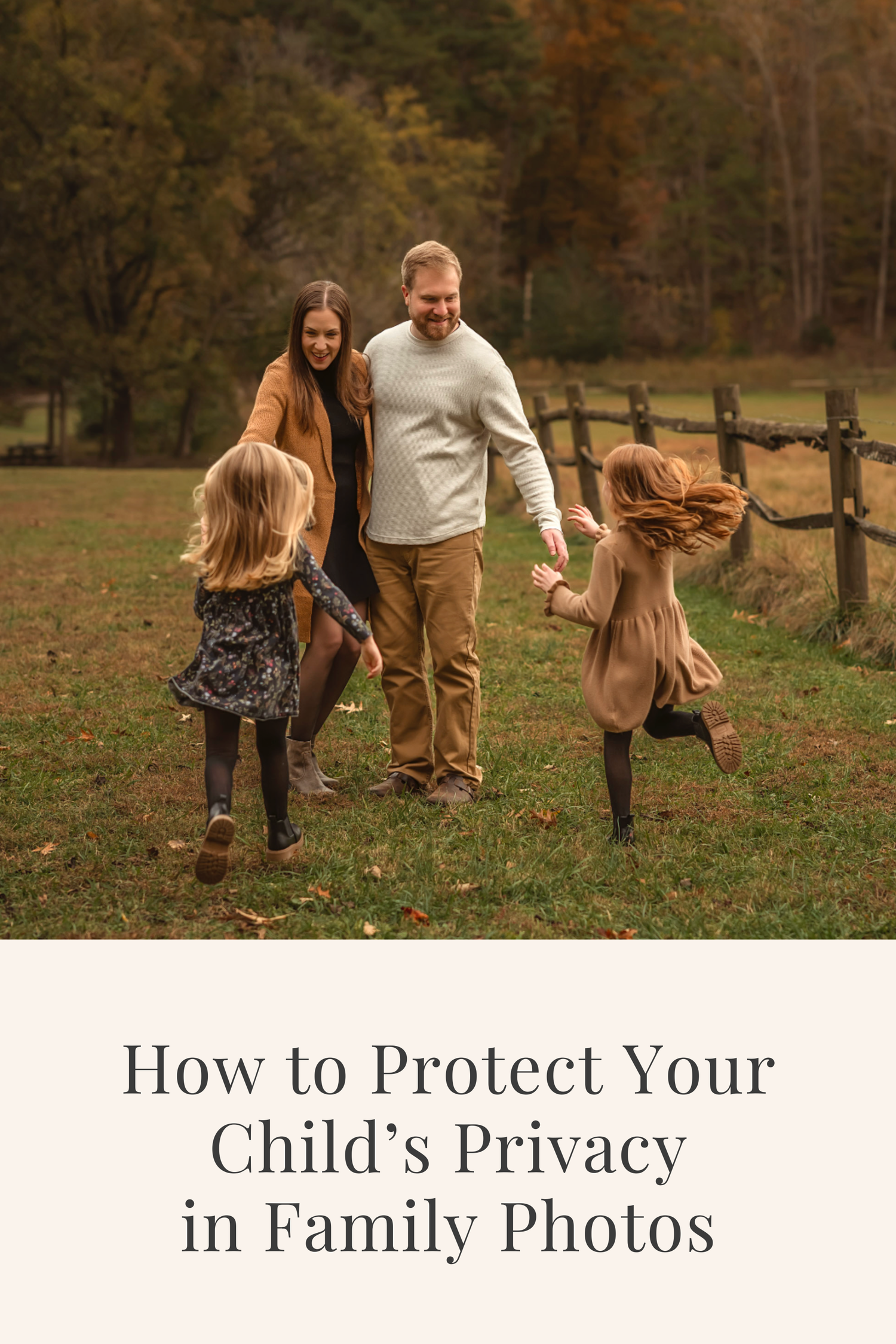
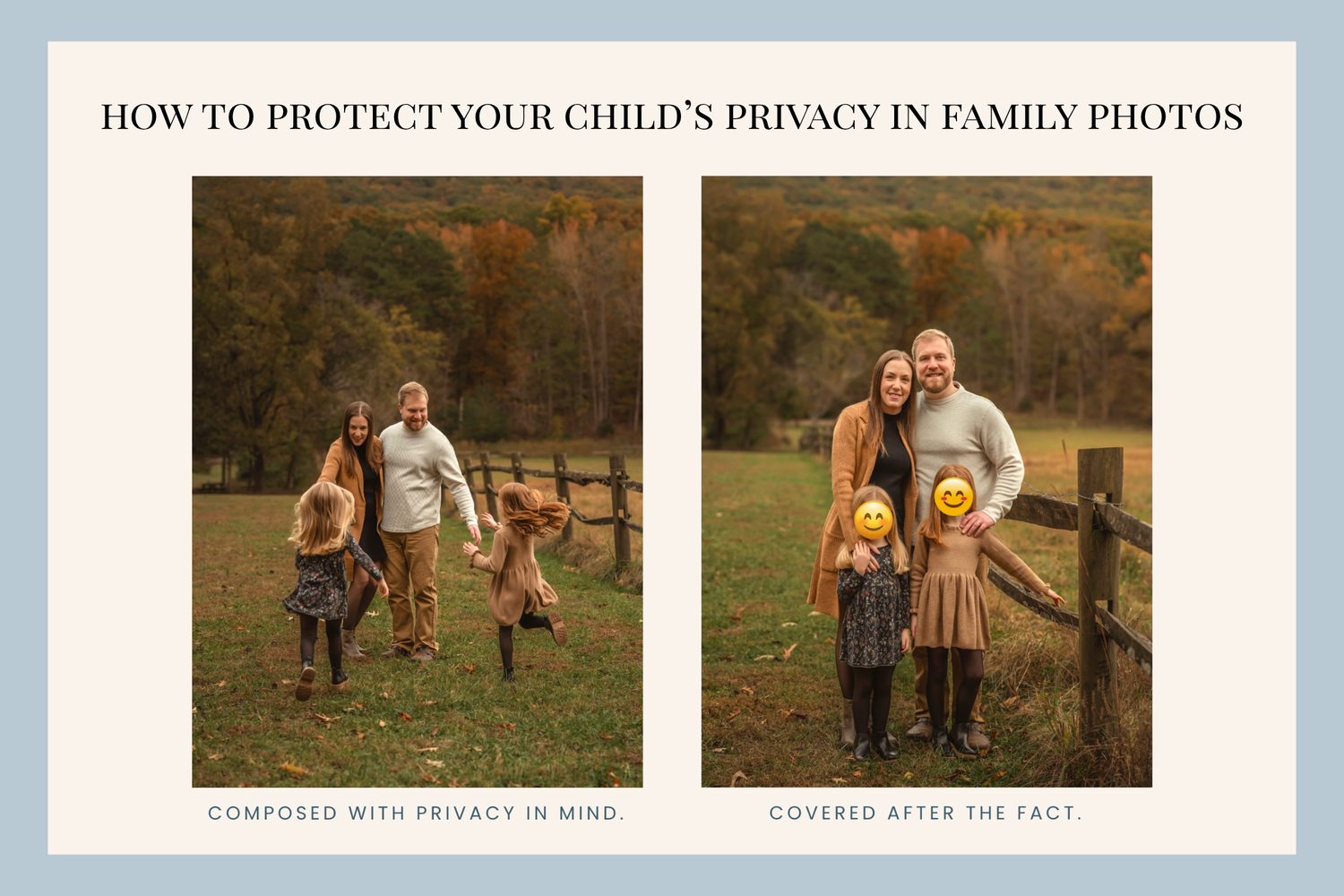
If you would like a few photographs you can share publicly without showing your child’s face, tell your photographer before the session. Your child’s privacy can then become part of the composition from the beginning instead of something you have to create afterward by covering a face with an emoji or sticker.

composed with privacy in mind.

covered after the fact.
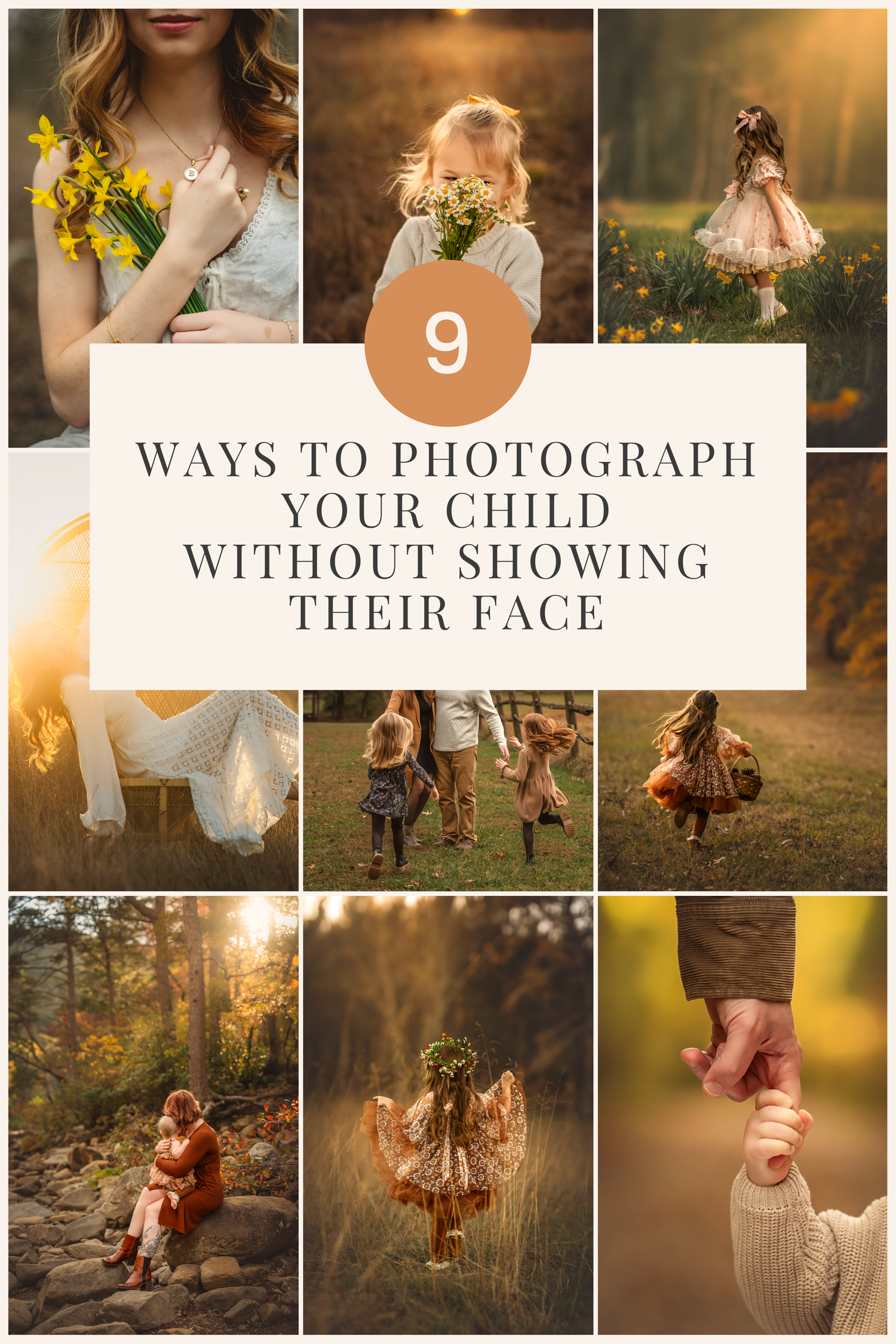
This does not mean your entire gallery has to consist of backs, silhouettes, and cropped details. Your photographer can create traditional portraits showing your child’s face for your family, album, or framed artwork while also intentionally creating a smaller selection for public sharing. Those shareable photographs might include several different approaches:
9 prompts for shareable photos without showing children’s faces
01
Photographing your child from behind.
This can preserve recognizable details such as their hair, clothing, posture, and size without revealing their face.

02
Having your child look toward a parent.
Their face can be turned away from the camera while the photograph still shows the connection between them.

03
Holding, hugging, or resting together.
A child nestled against a parent’s shoulder or chest can create a meaningful portrait in which their face is naturally hidden, but the closeness between them is still visible.

04
Photographing the small details.
Close-up images of hands, curls, bare feet, or a child holding onto a parent can preserve details specific to this stage of childhood.

05
Using Light, silhouettes, shadows, or distance.
Light and perspective can make a child less identifiable while still creating a strong image.

06
Including movement.
Running, twirling, walking, or playing can naturally turn or partially obscure a child’s face without making the pose feel forced.

09
Focusing on an activity or interaction.
Reading together, picking flowers, baking, or playing with a favorite object can tell a story without requiring anyone to look at the camera.

07
Using objects to obscure your child’s face.
Flowers, books, hats, or other meaningful objects can conceal identifying features while becoming an intentional part of the photograph.

08
Using intentional framing or cropping.
A photograph can be composed around a gesture, relationship, or detail so that the child’s face is outside the frame rather than awkwardly removed later.


These photographs should not feel like compromised versions of the “real” ones. When created intentionally, they can still show personality, connection, movement, and how small your child was in your arms. They give you something meaningful and beautiful to share without revealing everything you prefer to keep private.
Consider What Else the Photograph Reveals
A child’s face is only one identifying detail. Before sharing a photograph, consider both what appears within the frame and the information included with the post, such as the caption or location tag. Together, they may reveal:
- Your child’s full name
- A school name or uniform
- Your home address or a recognizable location
- Regular activities and schedules
- Clubs, teams, or other affiliations
None of these details automatically makes a photograph inappropriate to share. It simply means that hiding your child’s face may not provide the level of privacy you intended if the rest of the post identifies them another way.
As the parent, you have both the right and the responsibility to decide what information about your child is shared. You also have the right to work with photographers and other professionals who understand your preferences and respect the boundaries you establish.

This Applies to Everyday Photos, Too
These considerations are not limited to professional portraits. A quick cell phone picture can reveal just as much—or sometimes more—about your child. A first-day-of-school photograph might include a school logo, teacher’s name, or personalized sign. A picture taken outside your home might show a house number, street sign, or recognizable landmark.
Before posting an everyday photograph, take a moment to look beyond your child’s face. Check the background, caption, and location tag for details you may not have intended to share.
How to Talk With Your Photographer About Privacy
If privacy is important to your family, discuss it with your photographer before booking whenever possible. Photographers have different policies, contracts, and methods for sharing their work, so it is better to understand your options before signing an agreement.
If your privacy preferences differ from the photographer’s standard policy, make sure the agreement is documented in the contract or a modified model release. A clear conversation protects your family’s boundaries, gives the photographer an opportunity to explain how the images will be handled, and allows those preferences to be considered while planning the session.
Questions you may want to ask include:
- Does your contract or model release allow you to share my child’s photographs, and can I decline that permission?
- Can I approve individual photographs for sharing while keeping the rest private?
- Where and how will you use any images I approve?
- Do you charge an additional fee if I decline or modify the model release?
- Who will be able to access the online gallery, and how long will you retain the photographs?
- Can we intentionally create a few photographs I can share without showing my child’s face?
Your Family Photographs Do Not Have to Be Public to Matter
There is no single privacy boundary that is right for every family. You may be comfortable sharing some photographs, choose to keep all of them private, or change your approach as your child grows. Your photographer’s role is not to make that decision for you, but to explain your options, respect your boundaries, and create photographs that work within them.
Your family photographs still have value even if they are never posted online. They can live in albums, hang on the walls of your home, and be preserved for the people they were created for in the first place.
You can preserve your child’s expressions and personality in photographs meant only for your family while also creating a few carefully composed images you can feel comfortable sharing. Privacy does not require your child to be absent from the family record.


Frequently Asked Questions About Privacy and Family Photos

Do I have to let my photographer share my family’s photographs?
Not necessarily, but every photographer has different policies. Before booking, review the contract and model release to determine whether permission to share is optional, required, or included automatically unless you request a change.
My clients may accept the standard model release, approve only certain photographs for sharing, or keep the entire gallery private.

What if I change my mind after signing a model release?
Contact your photographer as soon as possible and ask what can be changed. The answer will depend on the agreement you signed and whether any photographs have already been published.
A photographer may be able to stop using the images in the future or remove them from places they control. However, once a photograph has been shared publicly, it may have been saved, copied, or reposted elsewhere. Discussing your boundaries before signing is the best way to prevent that situation.

Will requesting privacy change my photography experience?
Not when you work with me. A request for privacy does not change the planning, attention, editing, or care your family receives. If you would like a few images that you feel comfortable sharing, we can plan those intentionally while also creating traditional portraits that remain private.
Creating photographs for you to share does not mean you must give me permission to share them. You may post your purchased images on your own personal accounts while asking me not to use them on my website, social media, or other marketing materials. These are separate decisions: you determine not only which photographs may appear publicly, but also who is permitted to publish them.

Is covering my child’s face with an emoji enough to protect their privacy?
Covering your child’s face prevents their facial features from being visible, but it does not necessarily make the post anonymous. The photograph, background, caption, or location tag may still reveal their name, school, location, activities, or other identifying information.
Whether an emoji provides enough privacy depends on the boundaries you have chosen. If you know before the session that you want photographs you can share without showing your child’s face, intentionally composing them that way will usually create a more polished image while revealing less.

Is an online gallery completely private?
There are ways to make an online gallery more private, such as a gallery password, anti-screenshotting protection, and a download PIN. While these types of protections limit who can access the photographs, they cannot guarantee complete privacy. Anyone who receives the link and password or PIN may still be able to view, download, or share the images.
Ask your photographer who can access the gallery, whether downloads are enabled, and how long it will remain online. You should also share the gallery only with people who will respect the privacy boundaries you have established.

Why do some photographers charge extra to keep photographs private?
Some photographers charge a privacy fee because keeping the images private removes their ability to use that session in their portfolio and marketing. Others build permission into their standard pricing and offer a discount to clients who allow the photographs to be shared. Either approach should be explained clearly before a client books.
I love being able to share the photographs I create, but I do not charge my clients more for choosing privacy. Ultimately, my clients hire me to create photographs for them—not to provide marketing material for me. Their wishes come first.
If a photographer’s model-release policy does not align with your family’s privacy needs, you should not feel guilty about choosing someone else. Find a photographer whose policies allow you to feel comfortable with both the experience and what happens to the photographs afterward.
Plan a Family Session That Respects Your Privacy
As a Marietta photographer serving families throughout the Atlanta area, I believe you should remain in control of how your family’s photographs are used. Whether you want your entire gallery kept private, prefer to approve only certain images for sharing, or would like a few photographs created specifically for you to share without showing your child’s face, we can plan accordingly.
You do not need to have every detail decided before reaching out. Use the contact form to tell me a little about your family, the photographs you would like to create, and any privacy concerns you already have. We can work through the remaining decisions together.
Beautiful family photography—fully guided from planning to finished artwork, with your privacy preferences respected throughout.


Use these graphics for easy pinning to pinterest
Explore More Meaningful Photographs That Keep Children’s Faces Private


Hi, I'm Christian!
(Michelle is my middle name) I’m a Marietta photographer serving families throughout the Atlanta area. I create beautifully polished portraits through a thoughtfully planned, fully guided experience—from the first conversation to finished artwork made for your home.
If you’re looking for beautiful family photography and an experienced photographer to guide you through the entire process, I’d love to hear from you.
